What does Greatwall Kinase do in leukaemia cells?
Our collaboration with Pedro Cutillas and Sandra Martin-Guerrero, who have recently moved to the Instituto de Parasitología y Biomedicina López-Neyra in Granada, is now published in EMBO Reports 1. The starting point for this project was the observation that AML cells are very sensitive to loss of Greatwall kinase. While investigating what happens when AML cells loose Greatwall activity we stumbled on a suprising discovery. I want to use this blog to briefly explain what we found, and then spend a bit more time on the questions this work raises, because I think they could have a wider impact on the way we think about cell cycle control and cancer.
The textbook view
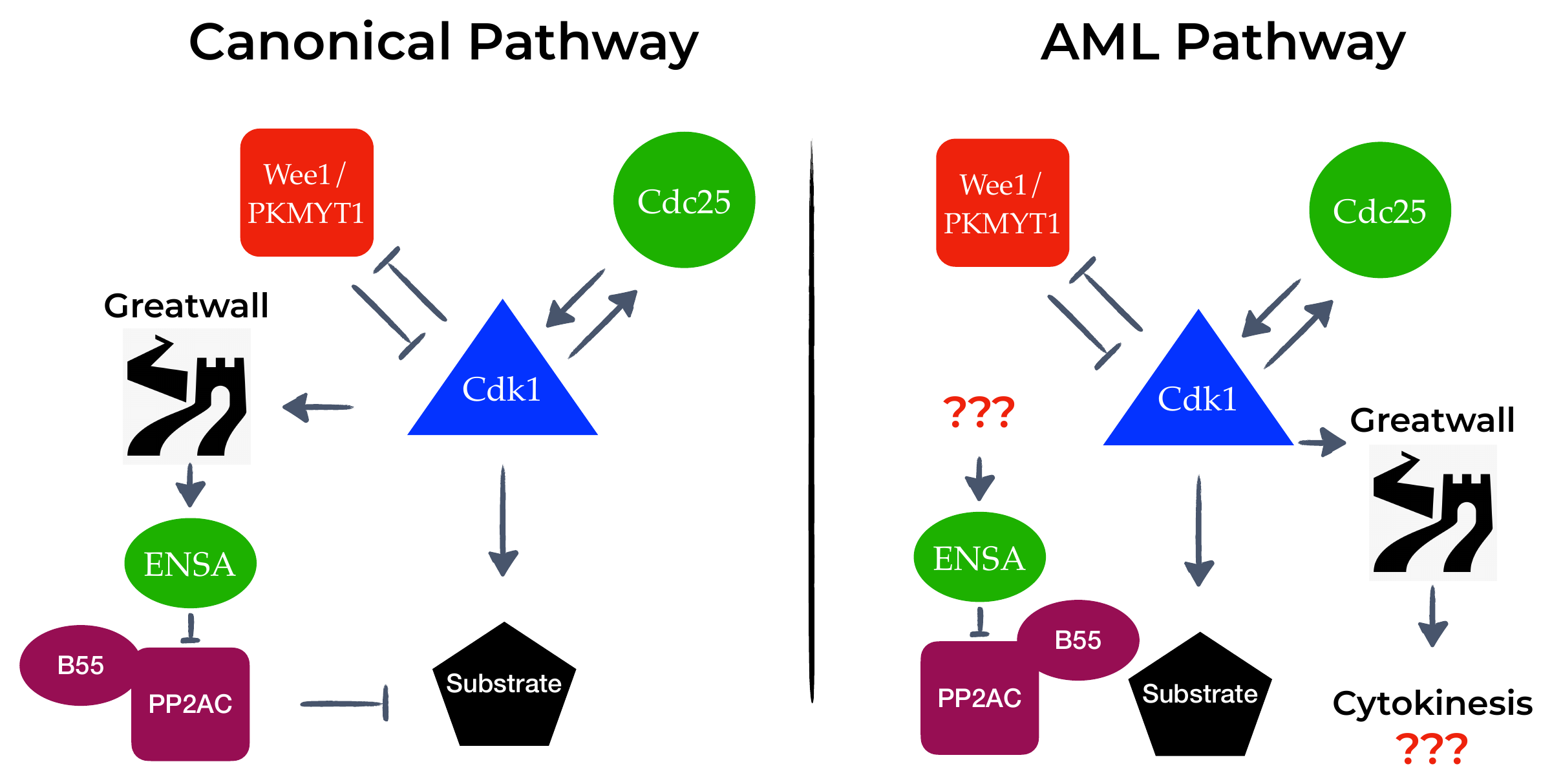
Greatwall (MASTL in human cells) has one well established job. At mitotic entry it phosphorylates two small proteins, ENSA and ARPP19, which then bind and inhibit the phosphatase PP2A:B55 234. PP2A:B55 is the main phosphatase that removes Cdk1 phosphorylation, so switching it off allows Cdk1 substrates to stay phosphorylated and the cell commits to mitosis. Greatwall activity tracks Cdk1 activation at mitotic entry and inactivation during exit. This ensures that while Cdk1 is active in mitosis, its main antagonistic phosphatase is switched of and avoids futile phosphorylation cycles. Based on this model, one would expect cells without Greatwall to struggle to get into mitosis or to stay there. But in mammalian cells, the phenotype we and others usually see is at the end of mitosis: cells fail in cytokinesis and abscission 56. This has always been a bit awkward to explain with the PP2A:B55 model alone.
What we found in AML
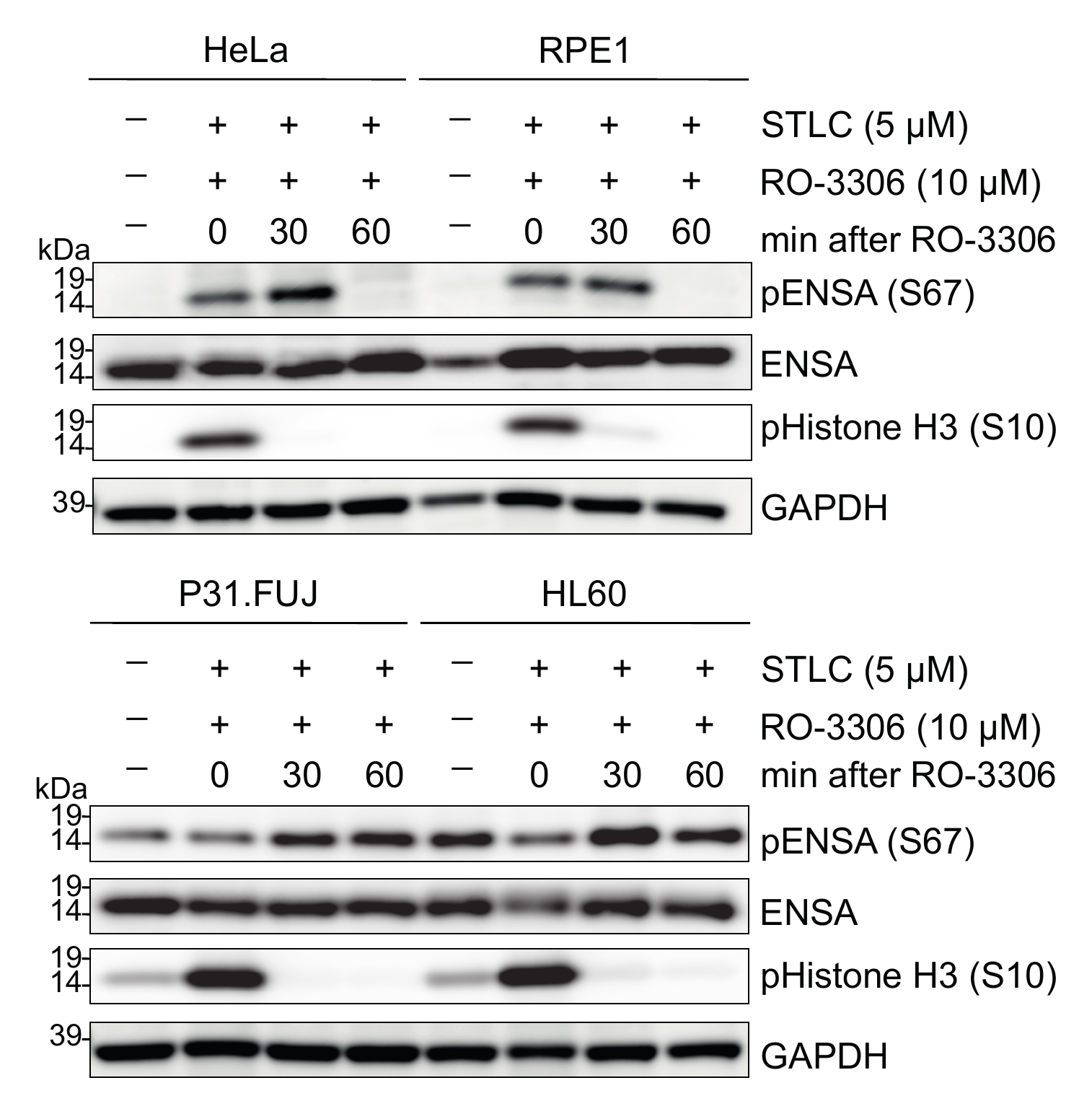
In AML cells the Greatwall/PP2A:B55 pathway seems to be wired differently. ENSA and ARPP19 are phosphorylated constitutively, and this phosphorylation does not depend on Greatwall. Inhibiting or depleting Greatwall had no measurable effect on the ENSA/ARPP19–PP2A:B55 axis both in immuno-blot and mass spectrometry assays. Nevertheless, AML cells still need Greatwall expression and kinase activity to proliferate, which we could show with both inhibitors and genetic perturbation. Without Greatwall the cells fail in cytokinesis. Sandra's and Pedro's phosphoproteomics pointed us to changes in the phosphorylation of proteins involved in cytoskeletal organisation and cytokinesis, and among these we identified MARK3 as a direct Greatwall substrate.
So what does this tell us? I see three open questions.
A core cell cycle module that is tissue specific
We tend to think of the cell cycle machinery as universal: the same pathways and switches act in in every cell. Here we have a core module, Greatwall–ENSA/ARPP19–PP2A:B55, that runs differently in a specific cell type. The kinase is still essential, but the module it normally controls works has been rewired to another control mechanism. I think this is an important point. A gene dependency tells you that a cell needs a protein, but not which of its functions the cell needs, and this can differ between tissues. Most of what we know about Greatwall comes from Xenopus egg extracts and a handful of mammalian cell lines, and it is easy to forget that this may not hold everywhere.
Why do AML cells keep ENSA/ARPP19 phosphorylated?
This is the question I find most intriguing. If ENSA and ARPP19 are phosphorylated all the time, PP2A:B55 is presumably inhibited throughout the cell cycle, not just in mitosis. PP2A is a well known tumour suppressor 7, and blocking PP2A activity is a recurrent theme in myeloid leukaemia. So one possibility is that constitutive ENSA/ARPP19 phosphorylation is a way for AML cells to switch off the tumour suppressor functions of PP2A:B55. If that is the case, the kinase doing this job would be an interesting new target in AML. We don't know yet which kinase it is. It is not Greatwall, so something else must be doing it, and finding it is high on our list.
What does Greatwall actually do in cytokinesis?
MARK3 is a direct Greatwall substrate, but MARK3 is not an essential gene. So its regulation is unlikely to be the only thing Greatwall does here, and there must be other substrates that make the kinase essential for cytokinesis in AML cells. Are these functions conserved in other tissues? So far the field has treated Greatwall more or less as a single-purpose kinase: it phosphorylates ENSA and ARPP19 to inhibit PP2A:B55, and that's it. Our story suggests there could be more to this kinase. It might also explain the awkward observation I mentioned above, that loss of Greatwall in mammalian cells usually results in cytokinesis and abscission defects. Perhaps some of these late mitotic phenotypes have little to do with PP2A:B55 and are caused by Greatwall substrates we haven't found yet.
These are the questions we want to follow up next. Many thanks to Sandra and Pedro for a great collaboration, and to Rob, Megan and Will from our lab for their contributions.
References
Footnotes
-
Sandra M. Martin-Guerrero et al., "Greatwall kinase regulates acute myeloid leukaemia cell division through a non-canonical mechanism," EMBO Reports (2026), doi:10.1038/s44319-026-00955-6. ↩
-
Priscila V. Castilho et al., "The M phase kinase Greatwall (Gwl) promotes inactivation of PP2A/B55δ, a phosphatase directed against CDK phosphosites," Molecular Biology of the Cell 20, no. 22 (2009): 4777-4789. ↩
-
Aicha Gharbi-Ayachi et al., "The substrate of Greatwall kinase, Arpp19, controls mitosis by inhibiting protein phosphatase 2A," Science 330, no. 6011 (2010): 1673-1677. ↩
-
Satoru Mochida et al., "Greatwall phosphorylates an inhibitor of protein phosphatase 2A that is essential for mitosis," Science 330, no. 6011 (2010): 1670-1673. ↩
-
Erik Voets, and Rob M. F. Wolthuis, "MASTL is the human orthologue of Greatwall kinase that facilitates mitotic entry, anaphase and cytokinesis," Cell Cycle 9, no. 17 (2010): 3591-3601. ↩
-
Andrew Burgess et al., "Loss of human Greatwall results in G2 arrest and multiple mitotic defects due to deregulation of the cyclin B-Cdc2/PP2A balance," PNAS 107, no. 28 (2010): 12564-12569. ↩
-
Jukka Westermarck, and William C. Hahn, "Multiple pathways regulated by the tumor suppressor PP2A in transformation," Trends in Molecular Medicine 14, no. 4 (2008): 152-160. ↩